Cisco AI Infrastructure Orders: Market Trends & Investor Analysis
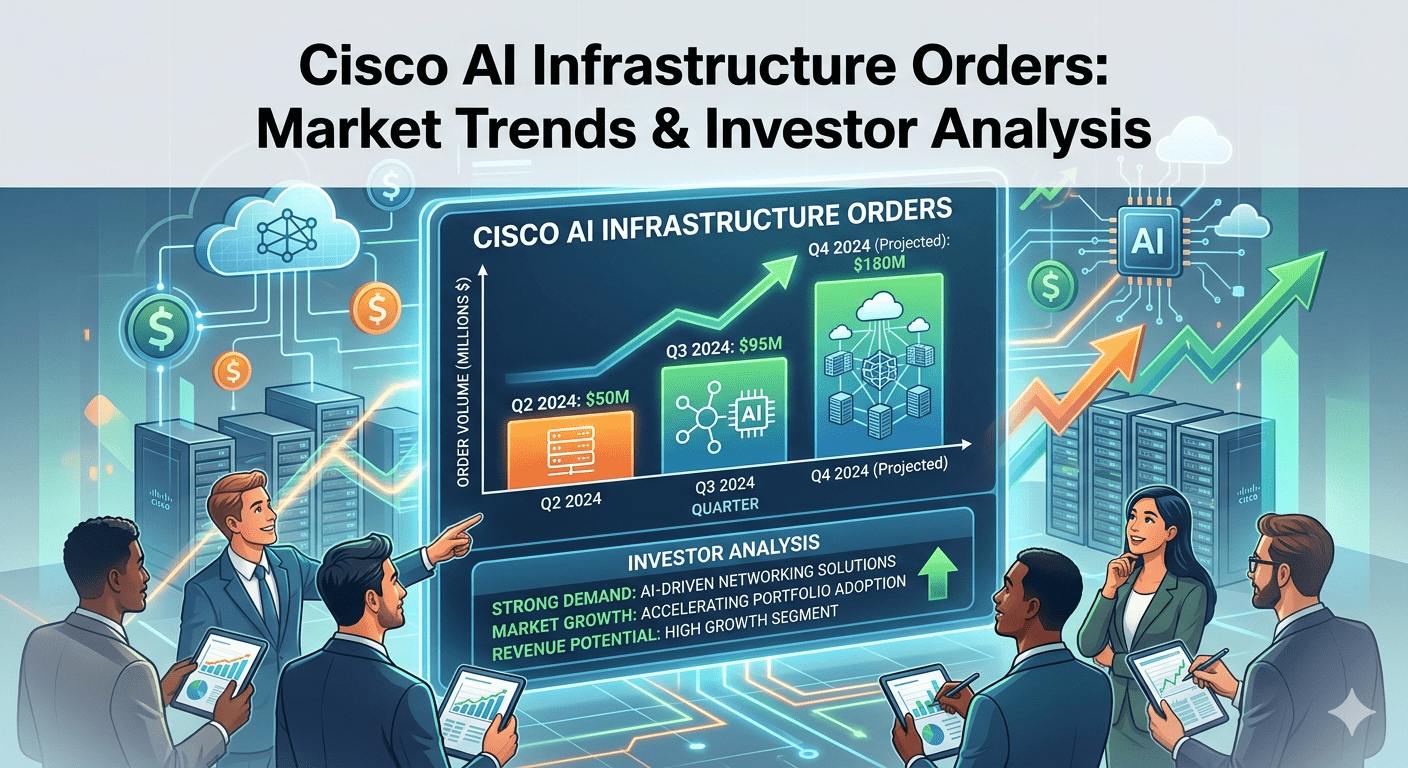
Everything investors, enterprise architects, and technology analysts need to understand about Cisco’s AI networking business — from quarterly order data to competitive positioning.
🏠 Step Tech📅 Last Updated: May 22, 2026🔖 Focus: Cisco AI Infrastructure Orders⏱ ~15 min read
Cisco AI NetworkingAI Infrastructure OrdersEnterprise AIHyperscaler DemandAI Data CenterSilicon OneInvestor Analysis
⚡ Quick Answer — Featured Snippet
Cisco AI infrastructure orders are purchases from enterprise and hyperscale cloud customers for AI-focused networking hardware — including high-speed Ethernet switches, optical connectivity, AI networking fabrics, and AI-ready data center systems — used to support GPU clusters and large-scale AI workloads. Investors track these orders because they indicate future AI-driven revenue growth, enterprise AI adoption trends, and the accelerating demand for next-generation networking required to run modern AI models.
$9BFY2026 AI Orders
Target (Raised Q3)
$5.3BFY2026 AI Orders
Year-to-Date (Q3)
$4BFY2026 AI Revenue
Guidance (Raised)
+12%Q3 FY2026 Revenue
Year-over-Year
What Are Cisco AI Infrastructure Orders?
Definition of AI Infrastructure Orders
Cisco AI infrastructure orders represent customer purchase commitments for Cisco networking and data center technologies specifically intended to power AI systems, GPU clusters, cloud-scale computing environments, and AI-ready enterprise data centers. These are not revenue figures — they are forward-looking demand signals that reflect what customers have committed to buying, which then converts into recognized revenue over subsequent quarters.
The term specifically covers Cisco’s sales to hyperscalers (large-scale cloud and internet providers who build and operate massive AI infrastructure) and increasingly to enterprise customers deploying AI systems on-premises or in hybrid environments. Cisco began breaking out AI infrastructure orders as a distinct reporting metric in fiscal year 2025, signaling the strategic importance of this segment to both management and investors.
Definition
AI infrastructure orders at Cisco specifically refer to signed purchase orders from hyperscale cloud customers and enterprises for high-performance networking hardware — switches, silicon, optics, and management software — that forms the backbone of GPU clusters and AI data centers. They are distinct from total product orders and are reported separately to highlight AI-specific demand.
How Cisco Generates AI Infrastructure Revenue
Cisco’s AI infrastructure business operates differently from traditional enterprise networking sales. The order-to-revenue conversion typically follows a multi-quarter cycle: a customer commits to a large purchase (the “order”), hardware is built and shipped, and revenue is recognized upon delivery and acceptance — often spread over several quarters for large contracts.
The company’s AI infrastructure revenue streams include: high-speed Ethernet switches built on proprietary Silicon One ASICs, optical transceivers and interconnects, AI-specific software such as Nexus One fabric management, security telemetry tools integrated via Splunk, and professional services supporting AI data center buildouts. Products like the Cisco N9000 series and the Silicon One G300 chip represent the core hardware driving this revenue category.
“The AI infrastructure orders we received from webscale customers in fiscal 2025 were more than double our original target, indicating a massive opportunity ahead as we lead the required architectural shift.”— Chuck Robbins, Chair and CEO, Cisco (FY2025 Q4 Earnings)
Difference Between Orders, Pipeline, and Revenue
Understanding these three terms is critical for interpreting Cisco’s AI momentum accurately. They are often confused but measure very different stages of the business cycle.
| Metric | What It Measures | Lag to Revenue | Investor Significance |
|---|---|---|---|
| AI Infrastructure Orders | Signed customer purchase commitments for AI networking hardware | 1–4 quarters | Leading indicator of future revenue; most forward-looking |
| AI Revenue Pipeline | Expected future revenue from orders already in backlog | Ongoing | Visibility into near-term revenue trajectory |
| AI Infrastructure Revenue | Revenue recognized in the quarter from AI-related product shipments | Current quarter | Direct P&L impact; lagging indicator |
Source: Step Tech analysis based on Cisco earnings disclosures. Order-to-revenue timelines are estimates.
Why Cisco AI Infrastructure Orders Matter
Why Investors Track AI Orders
For investors, AI infrastructure orders function as the most reliable leading indicator of Cisco’s growth trajectory in the AI era. Unlike revenue — which reflects what was shipped in the past quarter — orders reflect customer intent and commitment. A strong order quarter indicates that Cisco is winning AI infrastructure designs before competitors, locking in multi-year purchasing relationships, and gaining share in the most rapidly growing segment of the enterprise networking market.
The significance is amplified by the size of individual orders. Hyperscaler purchases tend to be large, multi-year commitments, meaning a single design win can translate into hundreds of millions of dollars of revenue over the product lifecycle. Rising AI infrastructure orders therefore signal not just near-term bookings but durable, long-term revenue relationships.
Enterprise AI Demand Signals
Beyond hyperscalers, Cisco’s AI infrastructure order trends reveal how quickly enterprises are modernizing their own data centers to support AI workloads. Agentic AI applications — systems where AI agents autonomously execute multi-step tasks — are driving a new wave of network traffic. Cisco CEO Chuck Robbins noted in Q1 FY2026 earnings that agentic AI queries were generating up to 25 times more network traffic than simple chatbot interactions, fundamentally changing the bandwidth requirements enterprise networks must support.
This creates a structural demand driver for Cisco’s campus and enterprise networking products, separate from the hyperscaler AI infrastructure story. The combination of AI-driven data center modernization and campus network refresh cycles positions Cisco to benefit from AI spending across multiple customer segments simultaneously.
Impact on Cisco Earnings and Valuation
AI infrastructure orders have had a direct and measurable impact on Cisco’s financial trajectory. In FY2025, Cisco originally projected $1 billion in AI infrastructure orders for the year. By Q3 FY2025, it had surpassed that target one quarter early. By the end of FY2025 Q4, the total had reached more than $1 billion for the quarter alone, bringing the full fiscal year total to over $3.1 billion — more than double the original target.
In FY2026, the acceleration intensified. Orders reached $1.3 billion in Q1, $2.1 billion in Q2, and $5.3 billion year-to-date through Q3 — prompting management to raise its full-year AI orders outlook to $9 billion (from the original $5 billion) and its AI revenue guidance to $4 billion (from $3 billion). For valuation purposes, the AI infrastructure business is increasingly seen as a high-growth, high-margin segment that deserves a premium multiple relative to Cisco’s traditional enterprise networking business.
Cisco AI Infrastructure Orders Tracker
The table below tracks Cisco AI infrastructure orders by quarter, as reported in official earnings disclosures. Data covers hyperscaler/webscale customers unless otherwise noted.
| Quarter | AI Orders (Hyperscaler) | QoQ Change | Cumulative FY Total | AI Revenue (Est.) | Management Commentary |
|---|---|---|---|---|---|
| Q1 FY2025 Oct 2024 | ~$350M | — | ~$350M | Early ramp | Initial AI order disclosure; momentum building |
| Q2 FY2025 Jan 2025 | >$350M | ~Flat | ~$700M | Ramp underway | H1 total of ~$700M disclosed; above initial trajectory |
| Q3 FY2025 Apr 2025 | >$600M | +~70% | ~$1.3B | ~$500M–700M | Surpassed $1B annual target one quarter early |
| Q4 FY2025 Jul 2025 | >$800M | +~30% | >$3.1B FY25 | ~$1B+ annualized | FY25 total 2× original $1B target; “massive opportunity ahead” |
| Q1 FY2026 Oct 2025 | $1.3B | +~60% | $1.3B FY26 | $3B FY26 guided | Significant acceleration; campus refresh also underway |
| Q2 FY2026 Jan 2026 | $2.1B | +62% | $3.4B FY26 | $3B+ FY26 guided | Single quarter matched entire FY2025 total; FY26 orders raised to $5B+ |
| Q3 FY2026 Apr 2026 | ~$1.9B | QoQ normalizing | $5.3B FY26 | $4B FY26 guided | FY26 orders guidance raised to $9B; revenue guidance raised to $4B |
Sources: Cisco Systems SEC Form 8-K filings (FY2025–FY2026). Revenue estimates reflect Cisco’s own guidance unless marked as analyst estimates. Q3 FY2026 single-quarter figure is implied from cumulative disclosure.
Cisco AI Infrastructure Products Explained
AI Networking Hardware
Cisco’s AI networking hardware portfolio is purpose-built for the demands of GPU clusters and AI data centers, where hundreds or thousands of accelerators must communicate at extremely high bandwidth with minimal latency. The core principle is building a lossless, high-throughput fabric where no GPU is waiting on the network rather than computing.
The hardware stack includes high-density Ethernet switches capable of 400G and 800G port speeds, coherent optical modules for long-distance AI data center interconnects, and specialized silicon designed to handle the bursty, all-to-all traffic patterns characteristic of AI training workloads. Unlike traditional enterprise switches designed primarily for north-south traffic (between users and servers), AI networking hardware is optimized for east-west traffic between GPU nodes within a cluster.
Cisco also offers the N9100 Series Switches, developed in partnership with NVIDIA, which combine Cisco’s enterprise-grade management and reliability with NVIDIA Spectrum-X silicon — delivering an NVIDIA Cloud Partner (NCP) compliant reference architecture used by neo-cloud and sovereign cloud operators to deploy large-scale AI training clusters.
Cisco Nexus and Silicon One
The two defining hardware pillars of Cisco’s AI infrastructure strategy are the Nexus switching platform and the Silicon One ASIC family.
Silicon One is Cisco’s proprietary networking chip, designed in-house to provide performance, programmability, and power efficiency characteristics tuned specifically for AI data center environments. The Silicon One G300 — unveiled in February 2026 — delivers 102.4 Tbps of switching capacity and is designed to power gigawatt-scale AI clusters for training, inference, and real-time agentic workloads. Cisco states the G300 improves GPU job completion time by 28% compared to previous generations. The companion Silicon One P200 chip targets “scale-across” networking, enabling AI workloads to span multiple data centers located up to 1,000 km apart.
The Nexus N9000 series, powered by Silicon One G300, offers 102.4 Tbps switching in systems designed for hyperscalers, neo-clouds, sovereign clouds, and large enterprises. The series is available in fully liquid-cooled configurations that — combined with advanced integrated optics — can improve energy efficiency by up to 70% compared to prior generation systems, a critical factor for hyperscalers operating at gigawatt scale.
The Nexus One management platform provides a unified control plane for AI fabric implementations, supporting Cisco ACI, SONiC, Nexus Hyperfabric, and other network operating environments through a single interface. It includes job-aware, network-to-GPU visibility that correlates network telemetry with AI workload behavior — enabling operators to identify whether a slow AI training job is caused by a networking bottleneck or a compute issue.
| Product | Category | Key Specification | AI Use Case |
|---|---|---|---|
| Silicon One G300 | Switching ASIC | 102.4 Tbps, 3nm | Hyperscale AI cluster switching; training & inference fabric |
| Silicon One P200 | Interconnect ASIC | 51.2 Tbps, scale-across | Multi-datacenter AI interconnect up to 1,000 km |
| Nexus N9000 Series | Data Center Switch | 102.4 Tbps, liquid cooling | AI cluster spine/leaf; hyperscaler & enterprise AI DC |
| N9100 Series (w/NVIDIA) | AI Training Switch | NVIDIA Spectrum-X silicon | NVIDIA NCP reference architecture; neocloud AI training |
| Nexus One | Management Platform | Multi-fabric unified mgmt | AI fabric operations; GPU-correlated network telemetry |
| Cisco 8000 Series | Routing Platform | Silicon One powered | AI data center interconnect; service provider AI transit |
Source: Cisco product announcements and investor materials, 2025–2026.
AI Security and Observability
Cisco’s AI infrastructure story extends beyond raw switching hardware to include the security and observability layers that enterprises require to operate AI systems at scale. The integration of Splunk (acquired by Cisco in 2024 for $28 billion) creates a powerful combination: Cisco’s network telemetry data fed directly into Splunk’s analytics platform, enabling real-time security monitoring, AI workload performance visibility, and compliance reporting without moving data off-premises — a critical requirement for sovereign cloud and regulated-industry customers.
Cisco’s AI security portfolio also addresses the specific threats that emerge when enterprises deploy AI: prompt injection attacks, model exfiltration, unauthorized API access to AI systems, and the lateral movement risks that arise when AI agents are granted broad system permissions. This positions Cisco not just as a networking infrastructure vendor in the AI era, but as a full-stack AI operations platform.
AI Infrastructure Market Trends Dashboard
AI Data Center Spending Trends
AI data center capital expenditure is the defining infrastructure investment theme of the mid-2020s. The leading hyperscalers — Microsoft, Google, Amazon, and Meta — have each disclosed multi-year, multi-hundred-billion-dollar AI infrastructure commitments. This spending translates directly into demand for the high-speed networking fabric that connects GPU clusters, and Cisco’s accelerating order trajectory reflects its growing share of this spending.
The composition of AI data center spending is also shifting. While GPU compute (primarily NVIDIA H100 and H200 clusters) dominated early AI infrastructure buildouts, the networking layer — previously treated as a cost-minimized commodity — is now recognized as a critical performance bottleneck. As GPU counts per cluster have grown into the thousands and even tens of thousands, the networking fabric connecting them has required proportional investment, creating the structural demand driver underpinning Cisco’s AI order acceleration.
GPU Networking Demand Growth
GPU cluster sizes are expanding rapidly as hyperscalers build infrastructure for frontier AI model training. First-generation clusters consisted of hundreds of GPUs; current-generation clusters regularly exceed 10,000 GPUs, with plans for clusters of 100,000+ GPUs under development. Each incremental GPU added to a cluster requires corresponding network bandwidth — a relationship that makes networking spend grow approximately linearly with compute spend in large-scale deployments.
The shift to agentic AI workloads introduces a further compounding factor. Unlike batch training workloads that can tolerate some network latency, agentic AI systems execute in real time, generating continuous streams of inference traffic as AI agents query models, tools, and databases. Cisco’s own measurement data — cited in Q1 FY2026 earnings — found that agentic AI traffic is 25 times more network-intensive than chatbot traffic, suggesting that enterprise network infrastructure built for the chatbot era will be significantly undersized for the agentic AI era.
Ethernet vs. InfiniBand Adoption
The networking technology choice for AI clusters has historically been a contentious market debate: InfiniBand (dominated by NVIDIA, particularly after its acquisition of Mellanox) versus high-speed Ethernet (where Cisco, Arista, and others compete). InfiniBand offered lower latency and purpose-built support for RDMA (Remote Direct Memory Access) workloads in AI training. Ethernet offered broader ecosystem support, lower cost at scale, and operational familiarity for data center teams.
The market has shifted meaningfully toward Ethernet over the 2024–2026 period, driven by several factors: the emergence of RoCE (RDMA over Converged Ethernet) technology that brings InfiniBand-like RDMA capabilities to Ethernet fabrics; the development of AI-specific Ethernet standards including enhancements to handle the bursty traffic patterns of GPU-to-GPU communication; and the sheer cost and ecosystem advantages of Ethernet at hyperscale. NVIDIA itself acknowledges the trend with its Spectrum-X Ethernet networking platform — and Cisco’s partnership with NVIDIA to integrate Spectrum-X silicon into Nexus switches is a direct product of this market evolution.
High-Speed Ethernet (Cisco)
- Ecosystem: Open, broad vendor support
- Cost: Lower at hyperscale
- Mgmt: Familiar, unified tools
- RDMA: Via RoCE / RoCEv2
- Adoption: Rapidly growing for AI
- Cisco Role: Core competitive strength
InfiniBand (NVIDIA)
- Ecosystem: Largely NVIDIA-controlled
- Cost: Premium, especially at scale
- Mgmt: Separate toolchain required
- RDMA: Native, mature
- Adoption: Dominant in legacy HPC clusters
- Cisco Role: Limited direct exposure
NVIDIA Spectrum-X Ethernet
- Ecosystem: NVIDIA silicon, open fabric
- Cost: Competitive
- Mgmt: NVIDIA tools + Cisco Nexus
- RDMA: Optimized for GPU-to-GPU
- Adoption: Growing fast in neoclouds
- Cisco Role: N9100 co-design with NVIDIA
Cisco vs. NVIDIA vs. Arista Networks
Cisco competes in the AI networking space against NVIDIA (InfiniBand and Spectrum-X), Arista Networks (cloud-optimized Ethernet), and Juniper (now part of HPE). Each has distinct strengths.
| Company | Primary AI Focus | Networking Strength | AI Revenue Exposure | Key Differentiator |
|---|---|---|---|---|
| Cisco | AI Ethernet fabric; enterprise & hyperscaler | Full stack: silicon to software; security integration | High & accelerating; $4B FY26 AI revenue guided | Proprietary Silicon One; Splunk integration; NVIDIA partnership |
| NVIDIA | InfiniBand for AI clusters; Spectrum-X Ethernet | AI-optimized interconnects; dominant GPU ecosystem | Very high; networking is secondary to GPU business | Tight GPU + networking integration; CUDA ecosystem lock-in |
| Arista Networks | Cloud-scale Ethernet switching; AI clusters | High-performance cloud switching; strong in hyperscalers | Significant; large hyperscaler customer base | EOS software; cloud-native architecture; close hyperscaler relationships |
| Juniper / HPE | Enterprise AI networking | Campus and enterprise-focused; Mist AI platform | Lower; primarily enterprise wireless/campus | AI-driven network operations (Mist AI); strong in campus |
Source: Step Tech analysis based on public company disclosures, 2025–2026.
Cisco vs. NVIDIA AI Infrastructure
The Cisco-NVIDIA dynamic is better described as a co-opetition than a direct rivalry. In the InfiniBand segment, NVIDIA has no meaningful Cisco competition — InfiniBand is a separate technology stack where Cisco has minimal presence. In the Ethernet networking segment for AI clusters, Cisco and NVIDIA compete in some scenarios (especially where customers are choosing between all-NVIDIA Spectrum-X and Cisco Nexus) but collaborate in others through their joint N9100 Switch development, which combines Cisco’s enterprise platform with NVIDIA’s AI-optimized silicon.
The strategic reality is that as the AI infrastructure market grows, there is enough demand for multiple technology approaches. Cisco wins when enterprises and cloud providers prioritize operational consistency, security integration, and multi-vendor flexibility. NVIDIA wins where GPU-to-networking co-optimization and CUDA-ecosystem integration are the primary decision criteria.
Cisco vs. Arista AI Networking
Arista is Cisco’s most direct competitor in high-speed Ethernet for AI data centers. Both companies target the same hyperscaler and enterprise customers with similar 400G/800G Ethernet products. Cisco’s differentiation lies in its proprietary Silicon One advantage (custom ASICs give Cisco more control over feature development timelines and cost structures), its broader portfolio spanning campus through cloud, and the Splunk security integration that Arista cannot easily replicate. Arista’s advantage lies in its deeply established hyperscaler relationships, its pure-play cloud networking focus, and a reputation for simplicity and performance that resonates with cloud-native engineering teams.
Enterprise AI Infrastructure Explained
What Is AI Infrastructure?
AI infrastructure refers to the hardware and software systems that enable artificial intelligence workloads — primarily the training of large AI models and the serving (inference) of those models to end users. It encompasses GPU servers, networking fabric, storage systems, power and cooling infrastructure, and the software that orchestrates and manages these resources. Networking is the connective tissue that allows all other components to function together at scale.
What Is a GPU Cluster?
A GPU cluster is a collection of graphics processing units (GPUs) connected via high-speed networking to work together on computationally intensive tasks like training large language models. Individual GPUs have high computational throughput but limited memory, so training large models requires hundreds or thousands of GPUs to share the computation across them — constantly communicating partial results via the network fabric. The speed and latency of this network directly determines how efficiently the GPUs can collaborate, which is why AI networking hardware is so performance-critical.
Why Networking Matters in AI
In a GPU cluster, every millisecond that a GPU spends waiting for data from another GPU is wasted compute. Network bottlenecks can reduce GPU utilization from 90%+ to 50% or less, effectively halving the value of extremely expensive GPU hardware. This is why customers building multi-billion-dollar GPU clusters invest heavily in premium networking — the economics justify paying a significant premium for faster, lower-latency switches that keep GPUs running rather than waiting.
Cisco’s Role in AI Networking
Cisco provides the switching, routing, and management software that forms the network fabric of AI data centers. When a hyperscaler deploys a cluster of 10,000 NVIDIA H100 GPUs, the high-speed Ethernet switches connecting them — potentially running Cisco’s Silicon One G300-powered Nexus switches — are what allow those GPUs to train AI models together. Cisco also provides the optics (fiber transceivers) that carry the signals between switches and servers, the management software that monitors and optimizes the fabric, and the security tools that protect the AI infrastructure from threats.
Cisco Earnings Commentary Breakdown
Key AI Themes from Earnings Calls
Cisco’s management has made AI infrastructure the central growth narrative in every earnings call since Q2 FY2025. Analyzing the progression of management commentary reveals a consistent pattern of raising expectations, expanding product announcements, and emphasizing the structural, multi-year nature of the AI demand cycle — all signals that Cisco views this as a fundamental business transformation rather than a cyclical uptick.
| Quarter | AI Order Result | Key Management Message | Guidance Action |
|---|---|---|---|
| Q2 FY2025 | ~$350M (Q); ~$700M (H1) | AI becoming pervasive; network infrastructure scaling required | Initial $1B FY25 AI order target maintained |
| Q3 FY2025 | >$600M | $1B target surpassed one quarter early; “massive opportunity” | FY25 target exceeded; FY26 $1B initial guidance |
| Q4 FY2025 | >$800M | FY25 total 2× original target; architectural shift in networking | FY26 AI orders target set at $1B (quickly revised upward) |
| Q1 FY2026 | $1.3B | Agentic AI 25× more traffic than chatbots; campus refresh underway | FY26 AI revenue guidance: $3B |
| Q2 FY2026 | $2.1B | Single quarter matched FY25 total; “significant acceleration” | FY26 AI orders raised to $5B+; AI revenue raised to $3B+ |
| Q3 FY2026 | $5.3B YTD | Record revenue; 50%+ networking order growth; design wins accelerating | FY26 AI orders raised to $9B; AI revenue raised to $4B |
Source: Cisco Systems SEC Form 8-K filings, FY2025–FY2026. Management guidance figures as disclosed.
Interpreting AI Infrastructure Demand
Several nuances are important when interpreting Cisco’s AI order data. First, the figures historically covered only hyperscaler/webscale customers — not enterprise orders. As enterprise AI deployments ramp, the total addressable order figure reported by Cisco may expand to include this customer segment, potentially inflating year-over-year comparisons. Second, large individual orders can cause significant quarterly volatility — a single hyperscaler placing a large multi-quarter order can move the reported figure substantially. Third, the conversion from orders to revenue remains uncertain in timing; large orders that slip from one quarter’s shipment schedule to the next will defer revenue recognition.
Enterprise & Investor Use Cases
Enterprise AI Deployments
Enterprises deploying private AI infrastructure — whether on-premises GPU clusters for proprietary model training, or hybrid environments mixing on-premises inference with cloud-based training — represent the next major wave of Cisco AI networking demand. Unlike hyperscalers who build their own data centers from scratch, enterprises typically retrofit existing data center infrastructure, requiring Cisco’s ability to operate in mixed environments (existing ACI fabrics alongside new AI-optimized Nexus deployments) and to provide the security and compliance features that regulated industries require. For more on enterprise AI strategy, see our guides to digital transformation and why AI implementations fail.
Cloud Infrastructure Expansion
Hyperscaler cloud providers continue to invest at unprecedented scale in AI infrastructure. As these providers expand their GPU fleets, each new GPU cluster requires network infrastructure — creating a highly predictable, multi-year demand pipeline for Cisco. The company’s design wins at hyperscalers (including confirmed Silicon One P200 wins announced in Q3 FY2026) provide multi-year revenue visibility, as hardware generations typically run for 3–5 years before the next major architectural transition.
AI Training Cluster Networking
AI training clusters represent the highest-performance, highest-bandwidth networking use case in existence. Training a frontier AI model on 10,000+ GPUs requires switching fabrics that can sustain all-to-all communication at full line rate — meaning every GPU can simultaneously send data to every other GPU without congestion. Cisco’s Silicon One G300, with its deep buffer architecture and 102.4 Tbps capacity, is specifically designed to handle these traffic patterns, including the support for RDMA over Ethernet that enables low-latency, CPU-bypass data transfers between GPU nodes.
Market Forecasting for Investors
For investors modeling Cisco’s AI infrastructure revenue trajectory, the key variables to track are: quarterly AI order bookings (leading indicator, 1–3 quarter lag to revenue), management guidance revisions (consistent upward revisions signal stronger-than-expected demand), design win announcements (each win locks in a multi-year revenue stream), and competitive dynamics in the Ethernet-for-AI market. The combination of $9 billion in FY2026 AI orders with a $4 billion revenue target implies a growing backlog that extends revenue visibility well into FY2027. For related technology investment analysis, explore our coverage of data company leaders and top technology trends.
Quick Lookup Reference
- Latest FY2026 AI order guidance: $9 billion (raised from $5B in Q3 FY2026)
- Latest FY2026 AI revenue guidance: $4 billion (raised from $3B)
- Latest quarterly AI orders (Q2 FY2026): $2.1 billion from hyperscalers
- Key AI networking product: Cisco Nexus N9000 Series with Silicon One G300 (102.4 Tbps)
- NVIDIA partnership product: Cisco N9100 Series with Spectrum-X silicon
- FY2025 AI orders total: >$3.1 billion (2× original $1B target)
- Key competitors: NVIDIA (InfiniBand + Spectrum-X), Arista Networks (Ethernet switching)
- Ethernet vs. InfiniBand trend: Ethernet adoption accelerating; RoCEv2 enables RDMA over Ethernet
- Security integration: Splunk + Cisco telemetry for AI workload observability
- Agentic AI traffic multiplier: 25× more network traffic vs. chatbots (per Cisco CEO)
Glossary of AI Infrastructure Terms
AI Infrastructure OrdersSigned purchase commitments from customers for networking hardware supporting AI workloads. A leading indicator of future revenue, typically converting 1–4 quarters after booking. GPU ClusterA collection of hundreds or thousands of graphics processing units connected via high-speed networking to collaboratively train or run AI models. HyperscalerLarge-scale cloud and internet service providers (e.g., Microsoft Azure, Google Cloud, Amazon AWS, Meta) that operate massive AI data center infrastructure. Silicon OneCisco’s proprietary family of network processing ASICs, designed in-house for high-performance AI data center and service provider networking. The G300 variant delivers 102.4 Tbps. AI Ethernet FabricA high-speed Ethernet network architecture optimized for GPU-to-GPU communication within AI clusters, supporting RDMA traffic patterns with low latency and high throughput. RoCE (RDMA over Converged Ethernet)A network protocol enabling Remote Direct Memory Access over standard Ethernet fabric, allowing GPUs to directly access each other’s memory without CPU overhead — critical for AI training performance. InfiniBandA high-performance networking interconnect technology, primarily sold by NVIDIA (via Mellanox), used in AI training clusters where native RDMA and ultra-low latency are required. Agentic AIAI systems where models autonomously execute multi-step tasks, query external tools and databases, and make sequential decisions — generating significantly higher and more continuous network traffic than batch inference. Nexus HyperfabricCisco’s cloud-managed AI networking fabric solution, providing simplified deployment and operations of AI data center networking for enterprise customers. AI Revenue PipelineThe forward-looking estimate of revenue expected from AI infrastructure orders already booked but not yet recognized — Cisco’s AI backlog provides visibility into future quarters.
FAQ: Cisco AI Infrastructure Orders
What are Cisco AI infrastructure orders?
Cisco AI infrastructure orders are signed purchase commitments from hyperscale cloud providers and enterprise customers for Cisco networking hardware — primarily high-speed Ethernet switches, AI networking fabrics, optical components, and AI data center management software — used to build and operate GPU clusters and AI data centers.
Why are Cisco AI infrastructure orders important to investors?
They are the most reliable leading indicator of Cisco’s AI-driven revenue trajectory. Orders typically convert to recognized revenue 1–4 quarters later, so strong order momentum signals future earnings growth well in advance. Cisco’s consistent upward guidance revisions throughout FY2025–FY2026 have been driven by stronger-than-expected AI order bookings.
How do AI infrastructure orders affect Cisco earnings?
Orders flow into backlog, which converts to revenue as products are shipped and accepted. Rising AI orders improve revenue visibility, reduce risk of earnings misses, and often trigger upward guidance revisions. They also signal mix shift toward higher-margin, higher-complexity systems — which over time can improve gross margins as the AI product portfolio matures.
What is the difference between AI orders and AI revenue?
AI orders are purchase commitments — what customers have agreed to buy. AI revenue is what Cisco has actually shipped and recognized on its income statement. Orders lead revenue by 1–4 quarters. A company can have rapidly growing orders while revenue growth lags — which is a normal and healthy pattern indicating a building backlog of future business.
How does Cisco compete with NVIDIA in AI infrastructure?
Cisco and NVIDIA compete in the Ethernet networking layer for AI clusters, while NVIDIA dominates the InfiniBand segment where Cisco has limited presence. The two companies also collaborate: the joint Cisco N9100 Switch combines Cisco’s enterprise platform with NVIDIA’s Spectrum-X silicon. Cisco’s advantages include proprietary Silicon One ASICs, deeper enterprise software integration, and the Splunk security platform.
Is Ethernet replacing InfiniBand for AI clusters?
Ethernet adoption for AI is growing significantly, driven by cost advantages, broader ecosystem support, and the maturation of RoCE (RDMA over Converged Ethernet) technology that gives Ethernet RDMA capabilities comparable to InfiniBand. Many hyperscalers and neo-cloud providers are choosing Ethernet-based fabrics for new AI cluster buildouts, which directly benefits Cisco, Arista, and NVIDIA’s Spectrum-X platform.
What role does networking play in AI data centers?
Networking is the connective tissue of AI data centers — it determines how efficiently thousands of GPUs can collaborate on training and inference workloads. Network bottlenecks directly reduce GPU utilization, wasting expensive compute resources. As GPU cluster sizes grow, networking investment scales proportionally, making high-speed Ethernet switching one of the fastest-growing infrastructure spending categories in AI data centers.
What are hyperscalers and why do they buy Cisco AI networking hardware?
Hyperscalers are large-scale cloud and internet providers — including the major public cloud platforms and large social media and e-commerce companies — that operate the world’s largest AI computing infrastructure. They buy Cisco AI networking hardware to build the high-speed, low-latency switching fabrics that connect their GPU clusters, enabling training of frontier AI models and serving AI inference at global scale.
Return to Step Tech Global: For more technology analysis, infrastructure guides, and AI market insights, visit Step Tech. Explore related coverage: Edge Computing · Zero Trust Security · Digital Transformation · Top Tech Trends · Why AI Fails · Data Company Leaders
📊 Key Numbers (FY2026)
$9BFY26 AI Orders Target
$4BFY26 AI Revenue Guided
$2.1BQ2 FY26 AI Orders
102.4TSilicon One G300 Capacity (bps)
+12%Q3 FY26 Revenue YoY
25×Agentic AI vs Chatbot Traffic
🔗 Related on Step Tech
- Edge Computing Use Cases
- Zero Trust Security
- Digital Transformation
- Data Company Leaders
- Top IoT Companies
- Smart Building Companies
- Top Tech Trends 2026
- Why 95% of AI Fails
- 7 Pillars of Digital Transformation
- Microservices vs Monolith
- Blockchain Applications
- Cybersecurity Threats
🏠 Step Tech Global
Technology intelligence for builders, investors, and curious minds.Visit Step Tech →
Disclaimer: This article is for informational and educational purposes only and does not constitute financial, investment, or legal advice. All data is sourced from publicly available Cisco Systems SEC filings and earnings disclosures. Cisco fiscal year ends in late July. Revenue guidance figures represent management projections, not guaranteed outcomes. Investors should conduct their own due diligence before making investment decisions.
© 2026 Step Tech Global — All rights reserved.Article: Cisco AI Infrastructure Orders | Updated May 2026← Back to Step Tech Home