Why Does 95% of AI Fail? Practical Insights for Enterprise Leaders in 2026
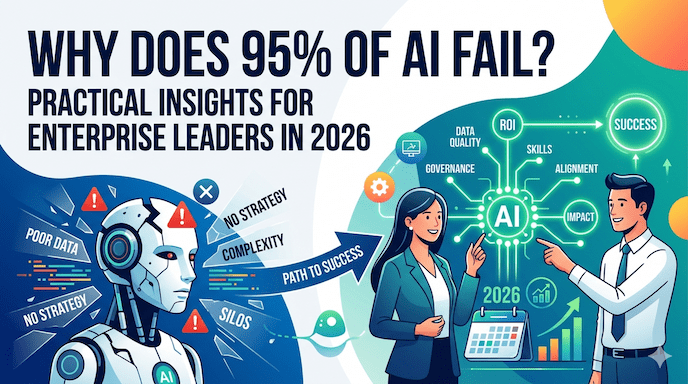
Why does 95% of AI fail in today’s enterprises? If you lead a company investing millions in artificial intelligence, this question likely keeps you up at night. Recent reports, including one from MIT’s NANDA initiative, highlight that 95% of generative AI pilots deliver little or no measurable impact on profit and loss statements.
As a CEO, CTO, or CFO, you already pour resources into AI transformation. Yet many initiatives stall at the pilot stage. Teams experiment with flashy tools, but few reach production with real business value. This creates frustration, wasted budgets, and missed opportunities.
This article explains why AI projects fail using verified data from MIT, Gartner, and industry studies. It targets decision-makers like you who seek practical answers, not hype. You will find clear reasons behind the AI project failure rate, common AI implementation challenges, and actionable strategies to join the successful 5%.
We break down complex topics into simple steps. By the end, you will understand how to close the AI pilot to production gap and measure true AI ROI effectively.
The Shocking Statistic: Understanding the 95% AI Failure Rate
The number comes up again and again: 95% of generative AI pilots at companies fail to create sustained value. MIT’s The GenAI Divide: State of AI in Business 2025 report, based on interviews with leaders, employee surveys, and analysis of over 300 public deployments, paints this picture clearly. Only about 5% of efforts achieve rapid revenue growth or marked productivity gains that executives notice on the P&L.
This AI project failure rate echoes broader enterprise IT challenges. Historical data shows many large IT projects fail at similar rates—sometimes up to 98% for complex ones, according to older CHAOS reports. AI feels different because the technology evolves quickly, but the core issues often mirror classic problems: unclear goals, poor execution, and resistance to change.
For enterprise decision-makers, the message is reassuring yet urgent. The technology itself is not broken. Models like advanced large language systems perform impressively in controlled settings. The failures stem from how organizations apply them in real workflows.
Generative AI pilot failure often happens because teams chase hype instead of solving specific pain points. Budgets flow heavily into sales and marketing tools—over half in some cases—while back-office automation, which delivers higher returns, gets less attention.
Why Does 95% of AI Fail? Top Root Causes Explained Simply
Why AI projects fail boils down to a few repeatable patterns. Here are the most common reasons, drawn from MIT findings and supporting research:
- Poor Workflow Integration and the Pilot-to-Production Gap. Many pilots work in isolation but break when teams try to embed them into daily operations. Generic tools like public chat interfaces succeed for individuals because they stay flexible. In enterprises, they fail to adapt to unique processes, data flows, or compliance needs. This creates an AI pilot to production gap. Internal builds succeed only about one-third of the time, while specialized vendor solutions hit closer to 67% success by focusing on fit and adoption.
- Data Quality Issues in AI and Lack of Structured Data. “Garbage in, garbage out” remains true. Weak, inconsistent, or siloed data undermines even the best models. Enterprises often lack AI-ready data—clean, governed, and accessible at scale. Gartner notes that organizations without proper data foundations risk abandoning over 60% of projects by 2026. Data quality issues in AI rank among the top barriers, leading to unreliable outputs and low trust.
- Misaligned Business Use Cases and Unclear ROI Projects launch without tight links to measurable business outcomes. Teams experiment broadly instead of targeting high-impact areas like finance automation or compliance. This fuels AI ROI failure and AI ROI measurement challenges. When success metrics stay vague, initiatives lose support quickly.
- Organizational Resistance and Change Management Failures: People resist when AI threatens routines or requires new skills. Change management in AI adoption often gets overlooked. Shadow AI—unsanctioned personal use of tools—spreads, while official projects stall due to organizational resistance to AI.
- MLOps Maturity Gaps and Model Deployment Challenges: Building a model differs from running it reliably at scale. Many teams face model deployment challenges, AI scalability problems, and immature MLOps practices. Monitoring, updating, and ensuring reliability become overwhelming without structured processes.
- Lack of Governance, Compliance, and Risk Controls: AI governance and compliance issues arise in regulated industries. Concerns around explainability, bias, security, and auditability slow progress. Enterprise AI risks grow when teams rush without proper frameworks.
- Automation vs Human Workflow Mismatch: Forcing AI to replace humans entirely often fails. Successful cases blend automation vs human workflow thoughtfully, using AI to augment decision-making rather than fully replace it. This ties into decision intelligence systems that combine data, models, and human judgment.
- Hype-Driven Experimentation Without Fundamentals Flashy proofs-of-concept dominate, but few invest in observability, validation, or training. This leads to an AI experimentation vs production systems disconnect and enterprise digital transformation failure.
These causes overlap. A project might start with exciting technology but collapse due to a lack of structured data for AI, weak integration, or missing executive sponsorship.
AI Implementation Challenges in Large Organizations
Enterprise settings amplify these problems. Complexity rises with scale—multiple departments, legacy systems, and strict regulations.
AI deployment problems often surface when moving beyond labs. Connectivity between systems fails, leading to workflow integration failure. Security teams block progress over concerns about data leaks or model hallucinations.
AI strategy failure in companies happens when central AI labs drive initiatives without input from line managers who understand daily operations. Empowering those closest to the work improves outcomes.
Talent gaps compound issues. Even with skilled AI engineers, business translation skills stay scarce. Teams struggle to turn technical prototypes into tools that deliver the business value of AI systems.
In 2025-2026 data, machine learning project failure rates remain high, similar to generative AI. Traditional models face the same AI scalability problems when data volumes or real-time needs grow.
Real-World Examples of AI Failure and Success
Consider a large manufacturer that spent heavily on a generative AI tool for contract review. The pilot looked promising in tests, but AI system reliability issues emerged in production—hallucinated clauses and poor handling of edge cases. Without deep workflow integration, adoption stayed low, and the project delivered zero P&L impact.
In contrast, a financial services firm partnered with a specialized vendor for accounts payable automation. They focused on back-office processes, cleaned core data, and integrated tightly with existing systems. Training emphasized practical use, governance ensured compliance, and metrics tracked cost savings directly. This effort landed in the successful 5%, reducing outsourcing costs significantly.
Startups sometimes outperform enterprises here. Young teams pick one sharp pain point, execute quickly, and partner smartly. They avoid the bloat that slows larger organizations.
These examples show why 95% of AI fail often trace to execution gaps rather than technology limits.
How to Beat the Odds: Practical Strategies for the Successful 5%
You can move your organization into the winning minority. Follow these actionable steps tailored for enterprise decision-makers:
- Start with a Clear Business Problem. Define one high-impact use case with measurable outcomes. Tie it to revenue, cost reduction, or risk mitigation. Avoid broad “AI transformation” efforts initially.
- Prioritize Data Foundations: Invest in data quality issues in AI fixes early. Build clean, governed datasets. Consider tools or partners that help create AI-ready data. This single step prevents many downstream failures.
- Choose Integration Over Invention. Evaluate buy-vs-build carefully. Specialized solutions often succeed faster because they handle model deployment challenges and MLOps maturity gaps better. Look for vendors that understand your industry workflows.
- Focus on Workflow Redesign: Treat AI as part of process improvement, not a bolt-on. Redesign flows to leverage automation while keeping humans in the loop where judgment matters. This addresses automation vs human workflow mismatch.
- Build Strong Change Management. Involve users from day one. Provide training, address fears openly, and celebrate early wins. Effective change management in AI adoption reduces organizational resistance to AI.
- Establish Governance Early. Create policies for AI governance and compliance. Define risk controls, explainability requirements, and monitoring processes. This builds trust and prevents surprises.
- Measure What Matters: Set clear KPIs for AI ROI. Track not just accuracy but business outcomes like time saved, errors reduced, or decisions improved. Address AI ROI measurement challenges with dashboards that line managers can understand.
- Scale Incrementally with MLOps. Use mature practices to handle AI scalability problems. Start small, monitor rigorously, and iterate based on real usage data.
- Leverage External Expertise Partner where needed. Successful cases often combine internal knowledge with vendor strengths for better AI business use case outcomes.
Tip: Create a cross-functional team including business leaders, IT, and compliance from the start. This prevents silos that fuel enterprise AI adoption issues.
Addressing Specific Challenges: Data, People, and Technology
Data quality issues in AI deserve extra attention. Many organizations underestimate how fragmented their data remains. Start with audits, then build pipelines for ongoing quality.
For people, focus on skills and culture. AI engineers and product managers need business context, while executives must champion realistic expectations.
On technology, close MLOps maturity gaps by adopting platforms that simplify deployment and monitoring. Explore edge computing or hybrid approaches when relevant for performance.
Startup founders reading this: Your agility gives an edge. Focus on vertical solutions and rapid iteration to avoid common enterprise pitfalls.
The Role of Leadership in Overcoming AI Strategy Failure
CEOs, CTOs, and CFOs set the tone. Sponsor projects with clear accountability. Ask tough questions about integration, data readiness, and ROI early.
Avoid spreading budgets too thin across many experiments. Concentrate on a few high-potential areas, especially back-office functions where ROI compounds.
Reassuring note: Failures in early pilots provide learning. The 5% that succeed treat setbacks as data points, not defeats.
Moving Beyond the 95% Failure Rate
As tools mature and best practices spread, more organizations will cross into consistent value creation. Agentic systems—AI that acts more autonomously—offer promise but come with their own risks; Gartner predicts over 40% of such projects may get canceled by 2027 due to costs or unclear value.
Focus on reliability, integration, and governance to stay ahead. Decision intelligence systems that blend AI with human oversight will likely dominate successful deployments.
FAQs
Why do 95% of AI projects fail in enterprises?
Most AI projects fail because they are not properly integrated into business workflows. Companies often focus on experimenting with AI models instead of solving real business problems, leading to poor ROI, weak adoption, and failure to scale beyond pilot stages.
What is the main reason AI pilot projects fail?
The biggest reason AI pilots fail is the gap between experimentation and production. Many pilots work in controlled environments but break when deployed in real-world systems due to poor integration, weak data infrastructure, and a lack of operational planning.
Is AI failing because the technology is weak?
No, AI technology itself is not the problem. Modern AI models perform very well. Failures usually come from poor implementation, low-quality data, unclear business goals, and a lack of organizational readiness.
What role does data quality play in AI failure?
Data quality is one of the top causes of AI failure. Incomplete, inconsistent, or siloed data leads to unreliable outputs, low trust in AI systems, and poor decision-making in business environments.
Why do companies struggle to scale AI from pilot to production?
Scaling AI is difficult because enterprises lack mature MLOps practices, system integration, and governance frameworks. Without proper infrastructure, models that work in testing environments often fail in production.
Conclusion
Why does 95% of AI fail? Not because the technology lacks power, but because most initiatives overlook critical fundamentals: tight workflow integration, high-quality data, clear business alignment, effective change management, and robust governance.
By understanding AI implementation challenges, why AI projects fail, and the AI pilot to production gap, you position your enterprise for better outcomes. The successful 5% prove it is possible—they focus on specific problems, invest in foundations, partner wisely, and measure real business value of AI systems.
Take one step today: Audit a current or planned AI initiative against the causes listed here. Adjust where needed to improve your chances of success.