Why Is Gen Z Struggling to Get Jobs? Real Reasons and Solutions for 2026 Graduates
Why is Gen Z struggling to get jobs? This question echoes across campuses and coffee shops as millions of young people finish their degrees and step into a tough job market for recent graduates. In Tier 1 and Tier 2 countries like the US, UK, Canada, Australia, and parts of Europe, recent data shows clear pressures. Over two million people earned bachelor’s degrees in spring 2025 in the US alone, yet only about 30% found full-time jobs in their field.
Many Gen Z graduates send out hundreds of applications with little response. Unemployment rates for recent college grads hover higher than the general population — sometimes reaching 9.7% or more in late 2025, compared to an overall rate around 4%. Gen Z unemployment rate stands notably elevated, often double the national average in some reports.
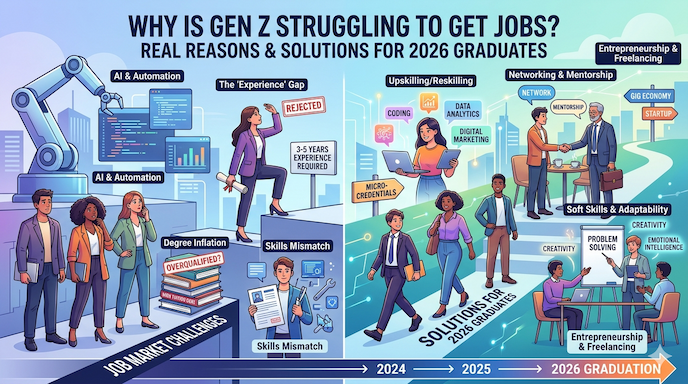
This is not just bad luck. Structural shifts explain why graduates can’t find jobs. Companies slowed hiring after post-pandemic over-hiring. Entry-level job shortage grew worse as AI and automation took over routine tasks. The classic lack of experience paradox hits hard: jobs labeled “entry-level” now demand years of skills that new grads rarely have. Add economic caution, high competition, and changing employer needs, and the result is a real fresh graduates job crisis for many.
This article breaks down the main causes behind Gen Z job market challenges in simple terms. You will find verified stats, clear examples, and helpful steps you can take right now. Whether you are a student, recent grad, or someone who hires or teaches young people, these insights aim to reassure you that understanding the landscape is the first step toward better outcomes.
Understanding the Scale of the Problem: Key Youth Unemployment Trends in 2025-2026
Youth unemployment trends paint a worrying picture for new workforce entrants. In the US, the share of unemployed people who are new to the workforce hit a 37-year high in 2025, peaking at 13.3% before easing slightly. Youth unemployment (ages 16-24 or similar) reached about 10.8% in mid-2025, well above the overall rate of around 4.3%.
Recent college graduates faced unemployment rates as high as 9.7% in some periods of 2025, nearly matching or exceeding rates for those with only high school diplomas in certain data sets. This narrowing “college premium” signals deeper issues in the job market for recent graduates.
In the UK and parts of Europe, similar pressures appear. Nearly one million young people aged 16-24 were NEET (not in education, employment, or training) at points in 2025. Global youth unemployment often runs more than double the rate for older workers, according to OECD observations.
Hiring slowdown trends play a big role. After strong hiring in 2021-2022, many firms pulled back. Layoffs reached high levels in 2025, with over a million announced cuts in the first ten months in the US. Companies kept existing staff in place, creating a “frozen” labor market where fewer openings appear for newcomers.
Why entry-level jobs are disappearing ties directly to these numbers. Postings for entry-level roles dropped roughly 35% since early 2023 in some analyses. When businesses tighten budgets, they reduce new hires first, hitting young people hardest.
The Shrinking Pool of Entry-Level Jobs: What the Data Shows
Entry-level job shortage has become one of the clearest Gen Z job market challenges. Businesses overhired during the recovery years and now move more slowly. A Cengage survey found 76% of employers hired the same number or fewer entry-level employees in 2025 than in 2024.
This creates intense job market competition 2026. Grads compete not only with each other but also with mid-career workers who stay put. Without people leaving roles, the bottom rung of the ladder stays crowded or missing.
Real stories illustrate the pain. Grads from strong schools report sending 100+ applications and waiting six months to a year with few interviews. Many end up in retail, hospitality, or unrelated gigs while still searching. This leads to underemployment among graduates, where people take jobs below their education level just to pay bills.
High living costs in big cities make things worse. In places like San Francisco or London, rents can eat 30-60% of a starter salary, leaving little room for financial breathing space during long job searches.
AI Replacing Entry-Level Jobs: Automation’s Growing Impact
One of the biggest drivers of why entry-level jobs are disappearing is technology. AI replacing entry-level jobs is no longer future talk — it is happening now.
AI tools handle tasks once given to juniors: drafting reports, basic data analysis, simple customer queries, content creation, and routine coding fixes. Companies use AI to fill gaps without adding headcount, slowing traditional hiring.
Studies show early-career workers in AI-exposed fields (like software, marketing, or admin roles) experienced employment declines of 13% or more relative to older colleagues. In some tech sectors, hiring for those with less than one year of experience dropped sharply.
Automation impact on jobs hits the bottom of the career ladder first. Entry-level positions traditionally served as training grounds. Now, AI performs many of those repeatable tasks, reducing the need for human starters. Some forecasts suggest AI could affect 50% or more of certain entry-level white-collar work in the coming years.
Yet AI does not destroy all opportunities. It shifts demand toward roles that combine human judgment with technology. The college degree vs skills debate grows louder because a degree alone no longer opens doors as easily. Employers want proof that you can work alongside AI tools effectively.
Hiring trends for Gen Z reflect this: firms prioritize candidates who show quick productivity and “durable” skills rather than those needing extensive training.
The Experience Paradox and Internship vs Experience Issue
A classic trap is the lack of experience paradox. Many “entry-level” postings ask for 2-5 years of experience. How can a fresh graduate meet that?
This creates the internship vs experience issue. Without prior work, it is hard to get a job. Internships used to solve this, but fewer paid or quality ones exist amid hiring caution. Many students graduate without meaningful hands-on time.
Labor experts note that organizations hire individuals, not just for their degrees. Success often depends on real experiences gained through internships, student organizations, part-time jobs, or personal projects.
The workforce readiness gap widens when education focuses heavily on theory while employers expect immediate contribution. Remote learning during the pandemic reduced chances to practice soft skills vs technical skills demand in real settings.
Skills Gap in Workforce: What Employers Really Want
Skills gap in workforce discussions often highlights differences between what colleges teach and what companies need.
Many managers report that Gen Z hires need more time and support to ramp up, especially in communication, problem-solving, collaboration, and professional presence. Some surveys show over a quarter of executives are hesitant to hire recent grads, and a notable portion of managers feel stressed managing them.
Soft skills vs technical skills demand has shifted. Technical knowledge matters, but so do “human” abilities that AI cannot easily replace: critical thinking, adaptability, emotional intelligence, and clear speaking/writing.
Employer expectations vs reality often clash. Companies want new hires who can contribute fast in lean teams. Grads sometimes arrive expecting more structured training that budgets no longer support.
The college degree vs skills debate questions whether four years of study still delivers the best return. Some young people pivot to trades or skilled manual roles where demand stays strong, and AI impact is lower. One example: a business degree holder who trained as an electrician and now earns a solid living through family business ties.
Overqualified but Underemployed: A Common Reality
Overqualified but underemployed describes many Gen Z graduates. They hold degrees but work in roles that do not use their education, leading to frustration and lower lifetime earnings potential.
This pattern echoes effects seen after the Great Recession, where poor early job markets led to years of lower wages and slower career progress. Long-term “scarring” can affect confidence and financial stability.
Underemployment among graduates also fuels mental health strain. Many describe the job search as a “mental war” requiring daily motivation when responses are few.
Gig Economy for Gen Z: Bridge or Trap?
The gig economy for Gen Z offers flexibility but often lacks benefits and stability. Driving, delivery, freelancing, or content creation can provide income while searching for full-time roles. However, it rarely builds the specific experience employers seek in traditional careers.
Some use gigs to demonstrate initiative and skills. Others find it hard to transition back to structured employment. Balancing gig work with targeted skill-building becomes key.
Economic and Structural Factors Behind the Crisis
Broader forces shape the fresh graduates job crisis:
- Post-pandemic adjustment and inflation concerns make companies cautious.
- Geopolitical issues and potential tariffs add uncertainty.
- Flatter organizational structures reduce middle layers that once absorbed juniors.
- Budget cuts hit training and development programs.
What Gen Z Can Do: Practical Steps to Stand Out
Understanding why is Gen Z struggling to get jobs helps you take control. Here are actionable ideas presented simply:
- Build real experience early — Seek internships, even unpaid or short ones. Participate in student media, clubs, or volunteer projects that develop transferable skills.
- Develop in-demand skills — Learn to use AI tools yourself. Practice prompt engineering, data interpretation, or basic coding. Combine this with strong soft skills like clear communication.
- Network actively — Referrals remain one of the best ways to get interviews. Attend industry events, connect on LinkedIn, and reach out politely to alumni or professionals.
- Tailor applications smartly — Customize resumes and cover letters. Highlight projects and results rather than just listing courses. Use keywords from job descriptions without stuffing.
- Consider alternative paths — Explore skills-based hiring, certifications, bootcamps, or trades where demand exists. Some fields still value hands-on ability over degrees.
- Start small and side projects — Freelance, create a portfolio website, or contribute to open-source work. These demonstrate initiative.
- Stay resilient and track progress — Set small weekly goals for applications and learning. Join support groups with other job seekers.
Focus on becoming the kind of person companies want to hire: curious, coachable, and able to add value quickly.
For those exploring entrepreneurship, strategies like bootstrapping or service-based models can provide routes around traditional hiring gates. Check related guides on sustainable business growth or common startup pitfalls to inform your thinking.
Role of Educators, HR, and Policymakers
Stakeholders share responsibility. Universities can strengthen career services, expand internship pipelines, and integrate practical skills across curricula. HR teams might create better onboarding, mentorship programs, and realistic entry roles that invest in potential.
Policymakers could support workforce training, affordable housing in job hubs, and active labor market programs to ease transitions.
The workforce readiness gap closes faster when education, employers, and government align better.
Hiring Trends for Gen Z in 2026 and Beyond
Looking ahead, hiring trends for Gen Z will likely mix caution with demand for hybrid skills. Skills-based hiring grows, with many employers dropping strict degree requirements in favor of proven abilities.
AI will continue reshaping roles, but new opportunities will emerge in AI oversight, ethical implementation, creative applications, and human-centered services.
Gen Z’s digital fluency and value for purpose-driven work can become strengths if paired with practical experience.
FAQs
Why is Gen Z struggling to get jobs?
Gen Z is struggling due to a mix of factors, including fewer entry-level jobs, increased competition, AI automation replacing routine tasks, and employers demanding experience even for junior roles. Economic uncertainty has also slowed hiring across many industries.
What are the main reasons Gen Z can’t find jobs after graduation?
The main reasons include the skills gap, lack of work experience, shrinking entry-level opportunities, and companies preferring experienced workers. Many graduates also face underemployment despite holding degrees.
Are entry-level jobs really disappearing?
Yes, many industries are reducing entry-level hiring. Automation and AI tools now handle tasks that used to be assigned to junior employees, while companies also cut costs by hiring fewer fresh graduates.
How does AI affect Gen Z job opportunities?
AI is reducing demand for routine entry-level tasks like data entry, basic analysis, and content drafting. This limits traditional starter roles but also creates new opportunities in AI-related and tech-driven fields.
What is the “experience paradox” in hiring?
The experience paradox refers to job postings that require 2–5 years of experience for entry-level roles. This makes it difficult for fresh graduates to qualify for jobs without prior work experience.
Conclusion
Why is Gen Z struggling to get jobs? The answer involves a mix of economic slowdowns, AI replacing entry-level jobs, skills gap in workforce, intense competition, and the persistent lack of experience paradox. Gen Z unemployment rate, entry-level job shortage, and youth unemployment trends reflect these real structural changes in the job market for recent graduates.
Yet this does not mean the situation is hopeless. Many young people are adapting by building skills, networking, gaining any experience possible, and exploring diverse paths like the gig economy or entrepreneurship.