Which 3 Jobs Will Survive AI? Bill Gates’ Prediction and Future-Proof Careers for 2026
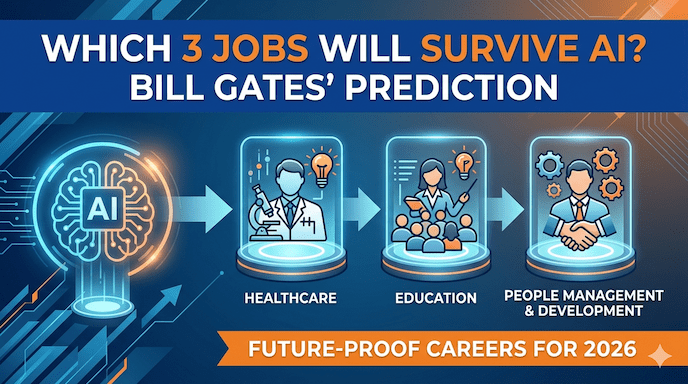
In a world changing fast because of artificial intelligence, many people wonder which 3 jobs will survive AI. Tech leader Bill Gates recently shared a clear view on this topic. He pointed to three key areas where human work will stay essential even as AI grows stronger.
Students, early professionals, and career switchers want stable paths. They seek jobs safe from AI that offer long-term security. This guide explains Gates’ ideas, why these roles resist automation, and how you can build a strong career. It also covers broader careers that AI cannot replace and future proof jobs 2026.
Bill Gates on AI and the Future of Work
Bill Gates, co-founder of Microsoft, has watched technology reshape jobs for decades. In recent comments, he highlighted that AI will change many roles but will not fully take over certain fields. He named three professions least likely to be automated end-to-end: coding/programming, biology, and energy work.
Gates explained that these jobs need judgment, creativity, and systems thinking that current AI models cannot fully copy or safely handle alone. He compared AI’s rise to past shifts like the Industrial Revolution or the internet boom. While some tasks will change, new opportunities often appear.
Microsoft studies have flagged roles with high AI overlap, such as interpreters or basic data work. Yet Gates stressed that AI mostly boosts productivity rather than erases entire payrolls. Humans still provide direction, critique, and real-world context.
His message brings reassurance: the future of work involves humans steering powerful tools, not being replaced by them. This view helps tech-aware users understand artificial intelligence impact on jobs without fear.
The Three Jobs Bill Gates Says Will Withstand AI
Gates focused on fields that hinge on complex human input. Here is a simple breakdown of which 3 jobs will survive AI according to his insights:
- Coders (Programmers and Software Developers) AI can write basic code, but building, debugging, and governing advanced AI systems need human oversight. Coders create the “scaffolding” for AI itself. They handle precision, security, and innovation that machines cannot manage alone. As AI grows, skilled coders become even more valuable because they refine and supervise the technology.
- Biologists (and Related Scientific Researchers). Biology involves forming new hypotheses, designing experiments, and making creative leaps in medicine or life sciences. AI excels at analyzing data, but it struggles with original thinking and clinical nuance. Biologists use intuition and careful judgment in unpredictable lab or real-world settings. This makes biology one of the careers that AI cannot replace.
- Energy Workers (Energy Sector Professionals) Managing energy grids, safety, crisis response, and sustainable solutions involves high-stakes decisions with physical and ethical consequences. AI can assist with analysis, but humans handle complex trade-offs, on-site judgment, and accountability. With growing demand for renewables and reliable power (including for AI data centers), this field offers strong job security in AI world.
These roles stand out because they combine technical knowledge with deeply human abilities like critical thinking, problem solving, and ethical responsibility.
Why These Jobs Are Resistant to Automation
Many experts study automation vs human jobs. Data from sources like “Will Robots Take My Job?” shows certain occupations carry 0.0% automation risk because they demand social skills, emotional intelligence, creativity, and flexibility in messy, real-life situations.
AI shines at repetitive, predictable tasks. It struggles with:
- Human creativity vs AI — coming up with truly novel ideas
- Critical thinking jobs — weighing incomplete information and ethics
- Problem solving careers — adapting to unexpected events
- Physical dexterity or on-site presence in variable conditions
- Building trust and empathy with people
Gates’ three areas require all these skills AI cannot replace. For example, a biologist might spot an unusual pattern in an experiment that sparks a breakthrough. An energy professional might make a split-second safety call during a storm. A coder might redesign an AI system to avoid harmful biases.
Studies show healthcare, education, and skilled trades also rank high among jobs resistant to automation. Nurse practitioners, therapists, and teachers often top growth lists with strong demand through 2032.
Broader List of Jobs Safe from AI in 2026
While Gates highlighted three standout fields, many other AI proof careers list options exist. Here are categories with low risk, backed by labor statistics and automation research:
Healthcare Roles (High Empathy and Complex Judgment)
- Nurse practitioners (projected 45.7% growth)
- Physician assistants
- Mental health counselors
- Physical and occupational therapists
- Surgeons and emergency physicians
These jobs need hands-on care, emotional support, and quick decisions in unpredictable patient situations. AI can help with diagnostics, but patients want a human connection.
Education and Training
- Nursing instructors
- Psychology or social work teachers
- Coaches and scouts
Teaching involves mentoring, motivation, and adapting to individual learners—areas where human skills vs machine learning make a big difference.
Creative and Design Fields
- Choreographers
- Set and exhibit designers
- Architects
Originality and artistic vision resist full automation.
Skilled Trades and Hands-On Services
- Electricians, plumbers, and HVAC technicians
- Firefighters and athletic trainers
These demand physical dexterity and real-time problem-solving in varied environments.
Leadership and Strategic Roles
- Chief executives (with strong interpersonal skills)
- Emergency management directors
High demand jobs after AI often blend technical knowledge with people skills. Careers in science and technology that emphasize innovation, like bioengineering, also stay strong.
Future of work trends show that roles requiring innovation driven professions or direct human interaction grow even as routine office work shrinks.
Skills AI Cannot Replace: What You Need to Thrive
To succeed in the safest jobs in the age of AI, focus on these irreplaceable human strengths:
- Emotional intelligence — understanding feelings and building trust
- Creativity and originality — generating fresh ideas
- Critical thinking and judgment — making wise choices with incomplete data
- Adaptability and flexibility — handling change and ambiguity
- Persuasion, negotiation, and communication — working with teams and clients
- Ethical reasoning — considering right and wrong in complex situations
Problem solving careers and critical thinking jobs reward people who combine these with domain knowledge. Gates advises building “literacies that travel” — practical coding fluency, core biological principles, energy systems understanding, plus strong communication and ethics.
Emerging technologies and employment will favor those who use AI as a tool while bringing the human edge.
How Students and Career Switchers Can Prepare for Future-Proof Jobs
If you are a student or early professional, start now to move toward low risk of automation paths:
- Build foundational skills in one of Gates’ three areas — learn coding basics, study biology, or explore energy and sustainability.
- Develop human skills through volunteering, group projects, or customer-facing work.
- Pursue certifications or degrees in growing fields like healthcare or renewable energy.
- Practice using AI tools yourself so you can supervise and improve them.
- Stay curious about digital transformation jobs, robotics, and employment impacts.
Career switchers can leverage existing experience. A teacher might move into corporate training. A manager could specialize in AI ethics or energy policy.
Consider side opportunities to test interests. Many explore service-based work or real-estate leads while building new skills. Focus on sustainable growth and honest evaluation of what brings income and satisfaction.
Challenges and Realistic Outlook on AI and Job Market Changes
AI will disrupt some roles. Reports mention net job shifts in certain sectors, with routine tasks automated first. Yet history shows technology often creates more work than it destroys when people adapt.
Job security in AI world comes from staying flexible. Gates himself notes his predictions may not be perfect — the job market evolves in surprising ways.
Focus on industries with rising demand: healthcare for aging populations, clean energy for climate goals, and technology that needs human governance.
Careers with low risk of automation share common traits: they are non-routine, socially rich, or physically complex.
Actionable Tips for Building an AI-Resistant Career
- Learn continuously — take courses in AI literacy alongside human-centered subjects.
- Gain hands-on experience — internships in hospitals, labs, or energy projects build irreplaceable skills.
- Network and communicate — strong relationships open doors that algorithms cannot.
- Develop a portfolio — show creative problem-solving through projects or volunteer work.
- Balance technical and soft skills — the best future professionals combine both.
Tips for success: Start small, track your progress, and seek mentors in stable fields. Remember, AI augments capable humans rather than replacing them outright.
FAQs
Which 3 jobs will survive AI according to Bill Gates?
According to Bill Gates, the three jobs most likely to survive AI are coders (software developers), biologists, and energy professionals. These roles require creativity, complex problem-solving, and human judgment that AI cannot fully replace.
Why are coders considered safe from AI?
Coders are essential because they build, manage, and improve AI systems. While AI can generate simple code, human developers are needed for debugging, security, innovation, and decision-making.
Can AI replace biologists or medical researchers?
AI can assist with data analysis, but it cannot fully replace biologists. Scientific research requires hypothesis creation, experimentation, and critical thinking, which depend heavily on human insight and creativity.
What makes energy sector jobs resistant to automation?
Energy jobs involve real-world operations, safety decisions, and complex systems management. Human professionals are needed to handle unexpected situations, ethical decisions, and infrastructure challenges.
Conclusion
Which 3 jobs will survive AI? According to Bill Gates, coding, biology, and energy work stand out because they demand creativity, judgment, and real-world responsibility that AI cannot fully replicate. Yet the bigger picture is encouraging: many jobs safe from AI exist across healthcare, education, trades, and innovation-driven fields. By focusing on human skills vs machine learning — empathy, critical thinking, and adaptability — you can build a stable, rewarding career.