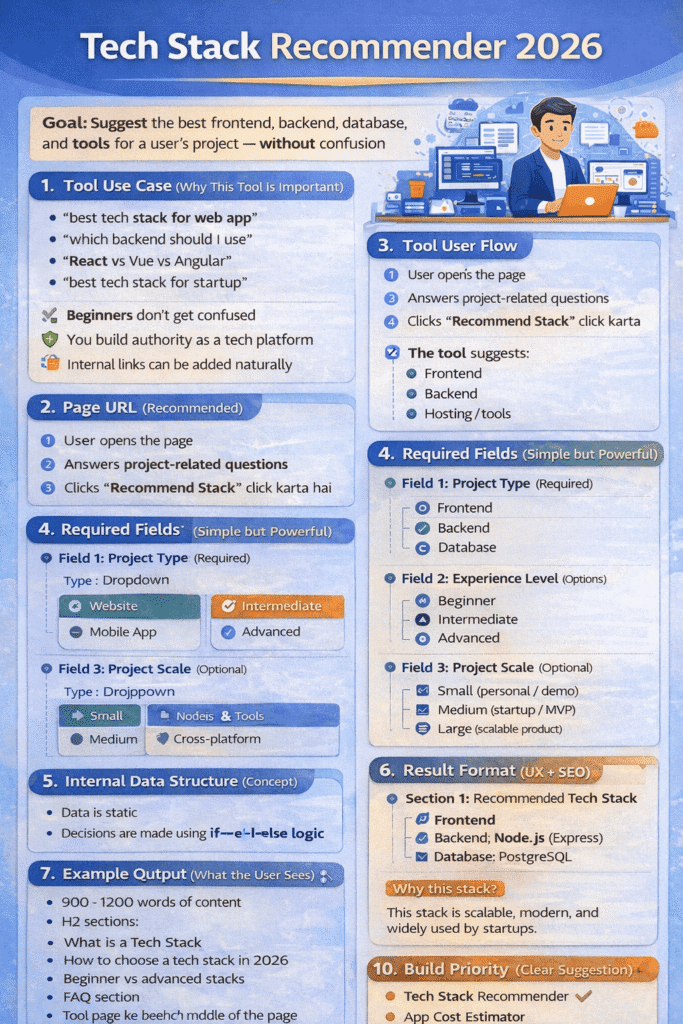
Choosing the right tech stack is one of the most important decisions in any software project. A wrong choice can slow development, increase costs, and create scalability issues later. This Tech Stack Recommender 2026 helps you select the most suitable technologies based on your project type, experience level, and long-term goals.
In 2026, software development is more specialized than ever. Different projects need different tools, and there is no single “best” tech stack for everything. This page explains how tech stacks work, how to choose them wisely, and how to use our free recommender tool.
What Is a Tech Stack?
A tech stack is a combination of programming languages, frameworks, libraries, and tools used to build a software product. It usually includes:
- Frontend: What users see and interact with
- Backend: Server-side logic and APIs
- Database: Where data is stored
- Tools: Development and deployment utilities
For example, a simple web application might use HTML, CSS, JavaScript on the frontend, PHP on the backend, and MySQL as the database.
Each layer of a tech stack plays a specific role, and choosing the right combination depends on the type of project you are building.
Why Choosing the Right Tech Stack Matters
A well-chosen tech stack can:
- Reduce development time
- Improve performance and scalability
- Make maintenance easier
- Help you hire developers more easily
- Lower long-term costs
On the other hand, a poor tech stack choice can cause performance bottlenecks and limit future growth. That’s why planning your stack before writing code is critical.
How to Choose a Tech Stack in 2026
In 2026, tech stack decisions are influenced by modern development needs such as scalability, security, and developer productivity. Here are the main factors you should consider.
1. Project Type
Different projects require different stacks:
- Websites need simplicity and speed
- Web applications need scalability and interactivity
- Mobile apps need cross-platform or native solutions
- SaaS products need long-term scalability
Your project type should always be the starting point.
2. Experience Level
Beginners should choose stacks that are easy to learn and well-documented. Advanced developers can handle more complex stacks optimized for performance and scalability.
3. Project Scale
Small personal projects do not need the same architecture as large products. A scalable stack is useful only if you actually plan to scale.
4. Performance and Maintenance
Some stacks are easier to maintain, while others focus on raw performance. In 2026, balancing both is more important than ever.
📌 Use the Tech Stack Recommender Tool
Tech Stack Recommender 2026
The tool above analyzes your project type, experience level, and priorities to recommend a suitable frontend, backend, database, and tools. It removes guesswork and gives you a clear starting point.
Beginner vs Advanced Tech Stacks
Not all tech stacks are suitable for everyone. Understanding the difference between beginner and advanced stacks helps avoid unnecessary complexity.
Beginner-Friendly Tech Stacks
Beginner stacks focus on simplicity and ease of learning. They usually include:
- HTML, CSS, and JavaScript
- PHP or basic Node.js
- MySQL or MongoDB
These stacks are ideal for learning fundamentals and building small to medium projects.
Advanced Tech Stacks
Advanced stacks focus on scalability, performance, and large systems. They often include:
- React or similar frontend frameworks
- Node.js, Django, or Spring Boot
- PostgreSQL or distributed databases
- Docker and CI/CD tools
These stacks are better suited for SaaS products and high-traffic applications.
Common Tech Stack Mistakes to Avoid
Many developers make the same mistakes when choosing a stack:
- Choosing a stack that is too complex for the project
- Following trends instead of project requirements
- Ignoring long-term maintenance
- Not considering team experience
The goal is not to use the newest tools, but the right tools.
Learning Path After Choosing a Tech Stack
Once you select a tech stack, follow a structured learning path:
- Learn frontend basics first
- Understand backend logic and APIs
- Practice database design
- Build a small complete project
- Improve performance and security
You can explore our:
- Frontend development tutorials
- Backend programming guides
- Project-based learning articles
Frequently Asked Questions (FAQ)
What is the best tech stack in 2026?
There is no single best tech stack. The best choice depends on your project type, experience level, and goals. This is why a recommender tool is useful.
Is one tech stack enough for all projects?
No. Different projects require different stacks. A website, mobile app, and SaaS product all have different needs.
Can beginners use advanced tech stacks?
Beginners can learn advanced stacks, but it is better to start simple and move to complex stacks gradually.
Should I change my tech stack later?
Yes, but only if there is a strong reason. Changing stacks mid-project can increase cost and complexity.
Does this tool use real-time data?
No. The tool uses logic-based recommendations based on best practices and industry standards.
Final Thoughts
Choosing a tech stack is a strategic decision, not just a technical one. With the right planning and tools, you can avoid confusion and build better software. Use the Tech Stack Recommender 2026 as a starting point, then focus on learning and building real projects.
The right stack will not only help you build faster but also grow confidently in your development career.